Technique
Surgeon preference card examples: a real one, line by line
It is the night before a case with an attending you have never scrubbed with. Someone tells you to "look at the card." You open it and find 60 lines of catalogue numbers.
Most searches for a surgeon preference card example end the same way: a description of a card, or a form that wants your email address. So here is a real one, read line by line, and then an orthopaedic example in the same shape.
The fast version: what every card has
| Section | What it holds | The question it answers |
|---|---|---|
| Header | Surgeon, procedure, location, glove sizes | Whose card is this? |
| Staff | Circulator, scrub, anesthesia roles needed | Who has to be in the room? |
| Equipment | Bed, imaging, power, tourniquet, towers | What gets wheeled in? |
| Instruments | Named trays and sets, with their storage bin | What does sterile processing pull? |
| Supplies | Drapes, blades, sutures, disposables, each with Open and PRN counts | What gets opened, and what waits? |
| Drugs | Irrigation, local, anything on the field, with amounts | What goes on the back table? |
| Positioning | Body position, arms, legs, padding | How does the patient go on the table? |
| Instructions | Nursing, prep and position notes | Anything that did not fit above |
The American College of Surgeons describes preference cards as surgeon- or procedure-specific documents that list "supplies, instruments, equipment, medications, positioning needs" for a case. It also notes that hospitals call them by different names: procedure cards, case setup cards, pick lists.
A real card, line by line
The best public example is one the American College of Surgeons published: a laparoscopic cholecystectomy card from a real hospital, shown before and after a standardization review. It is general surgery, not orthopaedics, but the format is the same everywhere. Here is what is on it.
The header. Surgeon, location, and the procedure variants the card covers. On this card one card covers several versions of the same operation, such as "possible open" and "with grams". The glove sizes sit right in the header, because the scrub needs them first.
Staff. A small table: circulator and scrub person required, plus anesthesia roles.
Equipment. Each line has an Open count, a PRN count, a "Required?" flag and a bin location. On this card that includes the electrosurgical unit, the CO2 insufflator, the video system, a fluoroscopy bed, a sequential compression pump and four X-ray aprons.
Instruments. Named trays, not single instruments, each with the bin and shelf where sterile processing finds it. The single instruments live inside the tray lists, which are separate documents.
Supplies. The longest section, and the one that costs money. Every line carries a type, a manufacturer number and two counts:
- Open: opened onto the field during setup.
- PRN: pulled into the room but left sealed until someone asks for it.
Drugs. Irrigation saline (1,000 mL), IV saline (1,000 mL) and bupivacaine 0.25% (30 mL), each with an Open or PRN count.
Positioning. Supine, both arms tucked, pillows under the knees, padded foot board.
Instructions. Free-text boxes for scheduling, nursing, prep and position. On this card the nursing box holds only the glove sizes, again.
What changed after the review
The "after" version is the same document with different counts. A few items were added or dropped, and several simply moved between Open and PRN:
- The surgical clipper went from opened every time to PRN.
- The suction waste manifold went from opened to PRN.
- The braided 0 suture went from PRN to two opened.
That is what "preference card optimization" means in practice. It is mostly arithmetic on the Open and PRN columns. The same ACS guide shows a tray review for mastectomy: five surgeons met for 1.5 hours with nursing and scrub tech leads, and cut the instruments in the general tray by 25%.
An orthopaedic example in the same shape
Below is an illustrative card for an ankle fracture ORIF, written in the same sections. It is not a recommendation. Every hospital and every surgeon is different, and the real card in your OR is the one that counts.
| Section | Example entry |
|---|---|
| Header | Ankle fracture ORIF, right or left. Surgeon's glove sizes |
| Equipment | Radiolucent table, C-arm, thigh tourniquet, power drill |
| Instruments | Small fragment set, basic orthopaedic tray |
| Implants | The plate and screw system this surgeon uses; rep needed yes or no |
| Supplies | Extremity drape, blades, sutures and dressing, each marked Open or PRN |
| Drugs | Irrigation, plus local anesthetic if this surgeon uses it |
| Positioning | Supine, with whatever bump or leg support this surgeon wants |
| Instructions | Which side the C-arm comes in from |
Every line here is about what is in the room. Nothing tells you what this attending does first, when you get the drill, or what they stop the case over.
The resident version: what the card leaves out
So you keep a second card, per surgeon and procedure, that holds the rest. Same case, different questions:
| Section | What you write down |
|---|---|
| Positioning | What actually happened: bump or no bump, where the C-arm came in, where you stood |
| Procedure steps | The order this attending did it, for example which fracture they fixed first. Just the order |
| Case cart | Anything they asked for that was not opened, so you can ask for it next time |
| Implants | The system and the sizes they reached for |
| Pearls and pitfalls | The two or three things that drew a correction, in their exact words |
| Post-op | Weight bearing, splint or boot, follow-up, as they wrote the orders |
Write it the same day. The details that matter are the ones that feel too obvious to write down at 6 pm and are gone by Thursday. For what to capture in two minutes after a case, see what to write down after every case. To turn it into a short list you run before you scrub, see how to build your own pre-case checklist.
Make one now, free
The free preference card builder on this site has exactly these sections. It runs in your browser, needs no account, prints a one-page card, and nothing you type is uploaded.
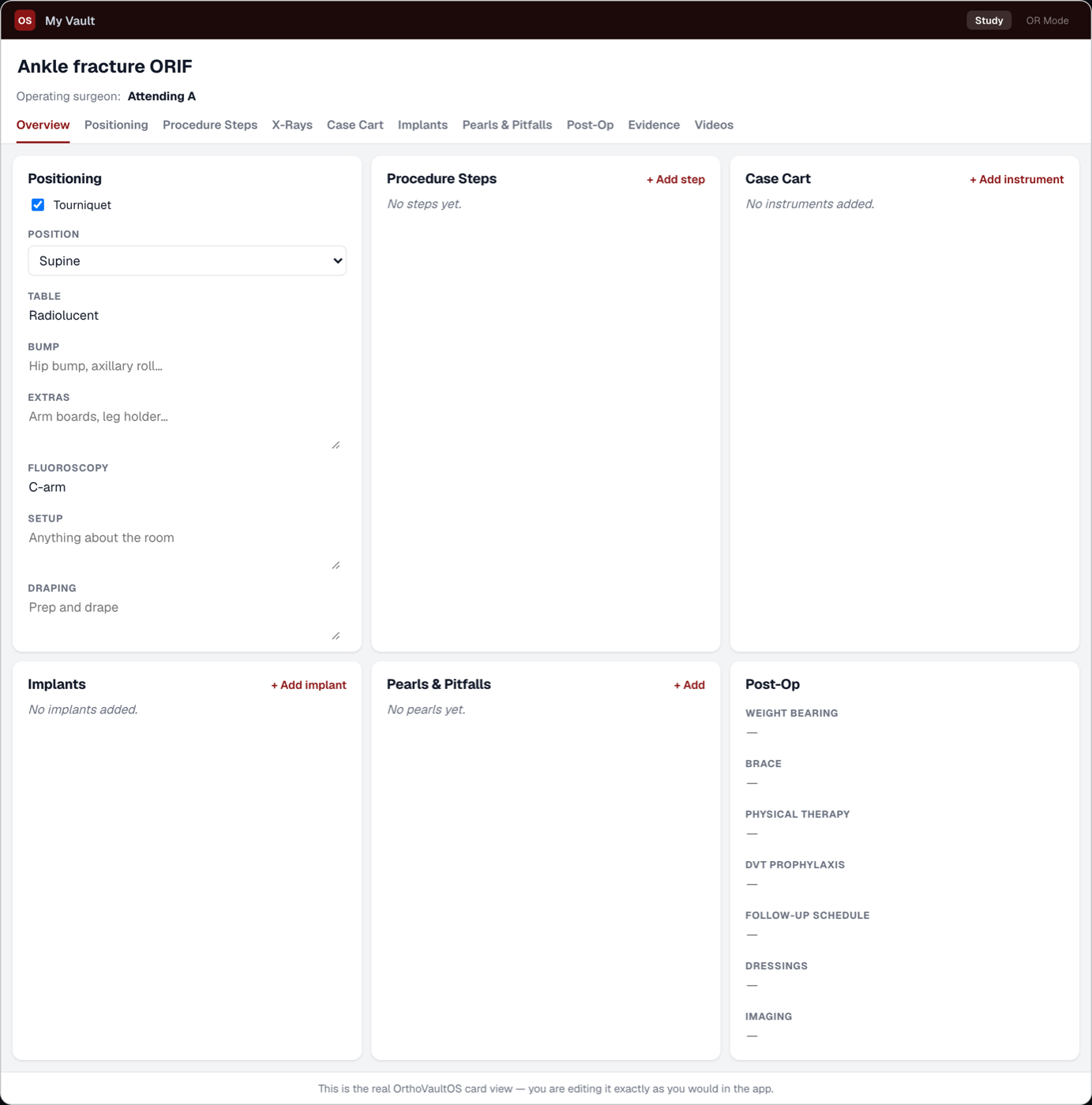
When you have more than one attending, OrthoVaultOS keeps a card per surgeon for every procedure.
Common questions
What should a surgeon preference card include?
Header (surgeon, procedure, glove sizes), staff, equipment, instrument trays, supplies with Open and PRN counts, drugs with amounts, positioning, and free-text instructions. That is the layout of the real card the American College of Surgeons published.
What does PRN mean on a preference card?
The item is pulled into the room but stays sealed until someone asks for it. Open means it is opened onto the field during setup. Moving items between the two columns is most of what a card review changes.
Who keeps the preference card up to date?
The hospital keeps it, built from what the surgeon asked for. It drifts when nobody updates it. More on that in surgeon preference cards explained.
Is there a free surgeon preference card template?
Yes. The preference card builder is free, needs no account and prints a one-page card.
Can I put patient details on my own card?
No. Keep technique and preference only: no names, no record numbers, no dates that identify a person. None of that is needed for the card to do its job.