Evidence
Burnout in residency: what actually helps, according to the data
It is 9 pm. You just finished the last note. You have a 5:30 am start, a talk to make, and a dentist appointment you have moved three times. You feel flat, not sad exactly, just done.
That feeling has a name, and it is common. In a national survey of 661 orthopaedic residents, 52% reported burnout. A meta-analysis of resident studies put orthopaedics in the highest group of specialties, alongside general surgery, anesthesiology and OB/GYN, at about 41%.
There is a lot of advice about what to do. Here is what the studies actually support, and how strongly.
The short version: what helps, and how sure we are
| What | What the studies found | How strong the evidence is | Who controls it |
|---|---|---|---|
| Fixing the work itself (workload, schedules, support) | In one meta-analysis, programs aimed at the organization had more than twice the effect of programs aimed at the person | Moderate. Pooled controlled studies, mixed quality | Your program |
| Coaching, one-on-one or in a group | Emotional exhaustion went down in two randomized trials. Feeling detached from patients did not change | Promising. Small pilot trials of volunteers | You can ask. Some programs pay for it |
| Small peer groups with protected time | Detachment from patients went down and stayed down a year later | One randomized trial, in practicing doctors | Program and you |
| Mindfulness training | Less stress and burnout in surgical residents. No change in depression or anxiety | Moderate. 179 residents, 5 studies | You |
| Changing duty-hour rules | No clear change in resident well-being in two large national trials | Strong trials, but well-being was not the main outcome | ACGME and your program |
| Wellness days | Most residents and program directors like the idea. Under half of residents who had them said they made a real difference | Weak. One survey | Your program |
| Less mistreatment | Residents mistreated a few times a month or more had about 3 times the odds of burnout | An association in a huge survey, not a trial | Program and attendings |
The pattern is simple. The biggest drivers sit with the program. The tools aimed at you work, but by modest amounts.
What is linked with burnout in orthopaedic residents
The 661-resident survey looked at which things went along with high emotional exhaustion. The strongest links were:
- Work volume that felt unmanageable (about 3 times the odds).
- Not being able to get to your own health appointments (about 3 times the odds).
- Feeling a lack of program support (about 3 times the odds).
- Not exercising (about 1.7 times the odds).
- Early training year.
Lack of co-resident support was tied to feeling detached from patients. 13% of residents also screened positive for depression.
These are links from one survey, not proof of cause. But most of them are things that can change, which is the authors' own point.
Burnout is not just a feeling, either. In one program of 62 orthopaedic residents, all three parts of burnout went along with lower in-training exam scores, even after accounting for Step 1 and Step 2 scores. PGY-2s had the highest scores for exhaustion and detachment. If you are studying for the OITE right now, how you study matters too.
Fixing the person vs fixing the job
Two big reviews pooled the trials on physician burnout.
The first, in The Lancet in 2016, combined 15 randomized trials and 37 cohort studies. Across the studies that measured it, overall burnout fell from 54% to 44%. High emotional exhaustion fell from 38% to 24%. The authors found that both personal and organizational fixes could help.
The second, in JAMA Internal Medicine in 2017, looked only at controlled studies: 19 studies, 1,550 doctors. The overall effect was small, about a 3-point drop on the exhaustion scale. But the split matters. Programs aimed at the organization had an effect size of 0.45. Programs aimed at the individual doctor had 0.18. The authors' reading: burnout is a problem of the whole health system, not of weak individuals.
That is worth saying out loud. If you are burned out, it does not mean you are doing residency wrong.
Coaching: the best individual evidence
Coaching has two randomized trials worth knowing.
- One-on-one coaching, practicing doctors. 88 physicians got 6 sessions with a professional coach or no coaching. After 6 months, emotional exhaustion dropped by 5.2 points with coaching and rose by 1.5 points without it. Overall burnout rates fell by 17.1% in the coached group and rose by 4.9% in the others.
- Online group coaching, women residents. 101 female residents (about 1 in 5 from surgical fields) were randomized to a 6-month web-based group program or usual training. Emotional exhaustion fell by 3.26 points with coaching and rose by 1.07 without it. Impostor feelings went down and self-compassion went up.
The honest caveats: both were small pilot trials of people who signed up because they wanted coaching. In both, feeling detached from patients did not change. And in the resident trial, fewer coached residents filled out the final survey (68% vs 88%), though a check for the missing answers gave similar results.
Still, the group format matters for residents. It is cheaper than one-on-one and fits around call. If your program offers coaching, it has some of the best evidence of any individual option.
Peer groups with protected time
In one trial, 74 doctors met in small facilitated groups every other week for 9 months, 19 sessions in all. The hospital paid for that hour. The groups mixed reflection, shared stories and some mindfulness.
High depersonalization (feeling detached from patients) fell by 15.5% in the group arm and rose by 0.8% in the control arm. The gap was still there a year later. Stress, depression and job satisfaction did not change.
This was in practicing doctors, not residents. But the key ingredient was protected time, which only a program can give.
Mindfulness
A 2025 meta-analysis pooled 5 studies (4 randomized) of 179 surgical residents. Mindfulness training lowered stress, burnout and emotional exhaustion. It did not change depression or anxiety. The authors rated the evidence moderate for stress and burnout.
So mindfulness is a reasonable tool, not a cure. It will not fix a schedule. It may make the same schedule feel a little lighter.
Duty hours: the rule changes did not move well-being much
The two biggest trials in residency education tested more flexible duty-hour rules against the standard ones.
- FIRST (general surgery, 117 programs, 4,330 residents). Dissatisfaction with well-being was 14.9% under flexible rules and 12.0% under standard rules, not a significant difference. Residents with flexible rules were less likely to leave in the middle of an operation or hand off active problems. They were more likely to say the rules hurt their personal life.
- iCOMPARE (internal medicine, 63 programs). Interns in flexible programs slept about the same: 6.85 vs 7.03 hours per 24 hours. But in a survey that half of the interns answered, those in flexible programs were more likely to be unhappy with their overall well-being. Program directors in flexible programs were happier.
Bottom line: tweaking the hour limits is not a burnout fix in either direction. For what the same trials say about sleep and skill, see does losing sleep make you a worse operator.
Mistreatment is a bigger lever than yoga
A national survey of 7,409 general surgery residents found that 38.5% had weekly burnout symptoms. Residents who faced discrimination, abuse or harassment a few times a month or more had 2.94 times the odds of burnout and about 3 times the odds of suicidal thoughts. Attendings were the most common source of abuse. The higher burnout rate in women disappeared once mistreatment was accounted for.
No breathing exercise fixes that. It is the program's job, and it is one of the clearest targets in the whole literature.
Wellness days and counseling: the gap between offer and use
A 2025 survey of orthopaedic residents and program directors found:
- Every program director said residents had been told how to get counseling. 26% of residents did not know.
- 60% of residents worried about confidentiality, while almost all program directors said it was confidential.
- About 63% in both groups thought wellness days could help. Only 43% of residents who had them said they made a real difference.
- Residents named lack of time (59%) and program attitudes toward mental health (39%) as the main barriers.
What you can do this week
Most of the big levers are not yours. These are:
- Find out how to get counseling, and whether it is confidential. Ask your GME office or wellness lead. Ask once, now, while you don't need it.
- Book your own health appointments and protect them. Not getting to them was one of the strongest links with exhaustion. Put the dentist on the schedule like a case.
- Ask whether your program offers coaching. Group coaching had a positive randomized trial in residents.
- Lean on your co-residents. A weekly meal, a group chat that isn't just about the list. Lack of co-resident support was tied to detachment.
- Move a little. Not exercising was linked with exhaustion. Even a short walk counts.
- Try a short mindfulness habit if it suits you. Moderate evidence, low cost.
- Tell someone about mistreatment through a channel you trust. A chief, a program director, an ombudsperson.
- Cut repeat work where you can. Small, but real.
If it is more than tired: if you are having thoughts of hurting yourself, call or text 988 in the US (Suicide and Crisis Lifeline), or tell someone today.
Cutting repeat work
Point 8 is the only one where a tool helps. A lot of a resident's evening goes to work you have done before: looking up how this attending likes the patient positioned, which implant they use, what they said last time. Writing it down once, where you can find it, means you don't redo it.
That is what OrthoVaultOS is for. It keeps one card per attending for each procedure, with positioning, steps, case cart and pearls in one place. We make no claim that it treats burnout. It saves some time and keeps your notes where you can find them.
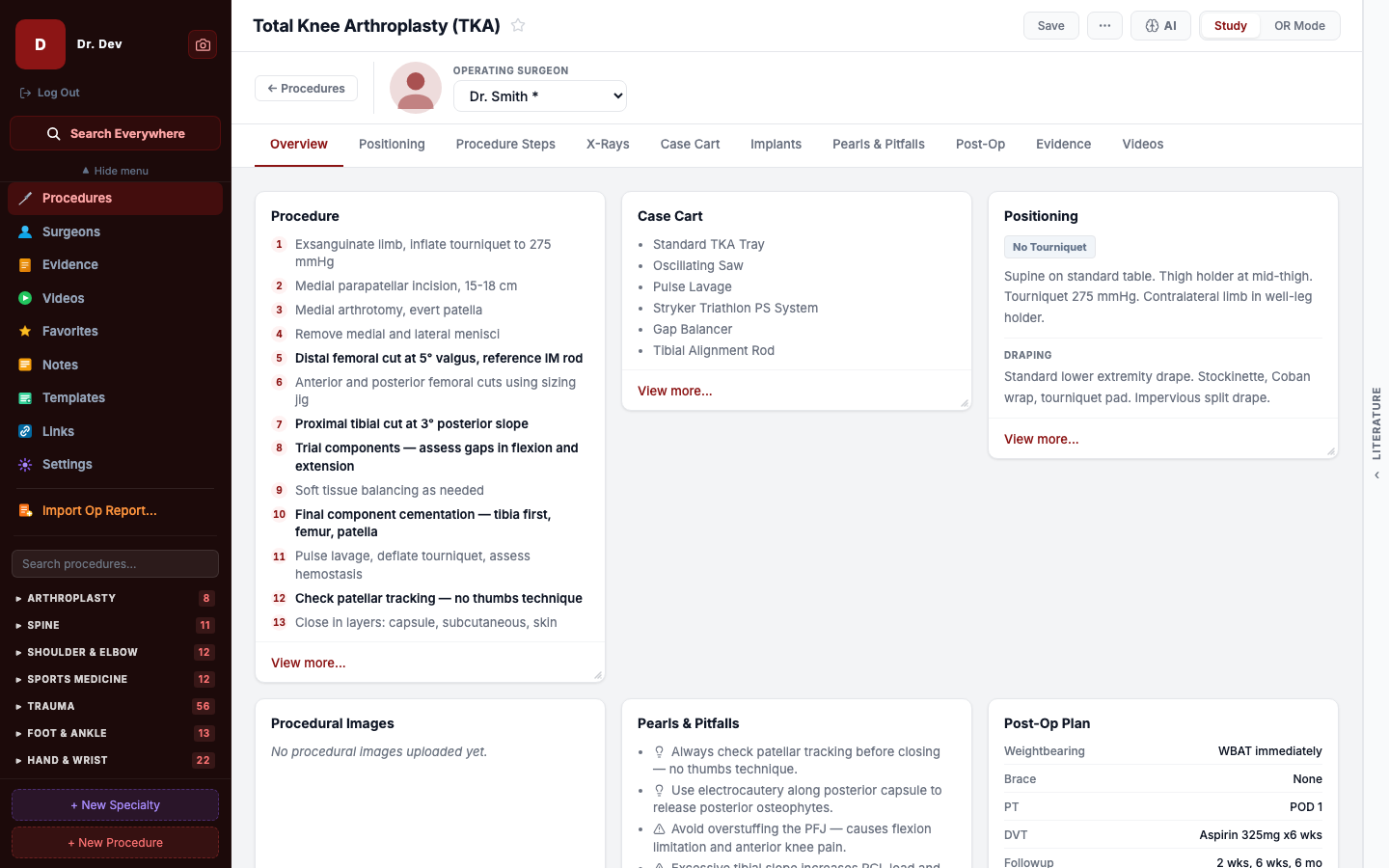
You don't have to start from a blank page. The free procedure library has 239 starter templates, and OrthoVaultOS is free to start. For what to put on each card, see what to write down after every case.
Common questions
How common is burnout in orthopaedic residency?
In a 2020 survey of 661 orthopaedic residents from 46 programs, 52% reported burnout. A meta-analysis of resident studies grouped orthopaedics with the highest-burnout specialties, at about 41%.
What is the most effective way to reduce resident burnout?
Changes to the work itself. In a meta-analysis of controlled studies, programs aimed at the organization had more than twice the effect of programs aimed at individual doctors. Among individual options, coaching has the strongest trial evidence.
Does coaching work for residents?
In a randomized trial of 101 women residents, 6 months of online group coaching lowered emotional exhaustion and impostor feelings. It was a small pilot trial of volunteers, and it did not change feelings of detachment from patients.
Do duty-hour limits reduce burnout?
The large trials did not show it. In the FIRST trial, resident dissatisfaction with well-being was not significantly different between flexible and standard rules. In iCOMPARE, interns slept about the same under both.
Does mindfulness help surgical residents?
A 2025 meta-analysis of 179 surgical residents found less stress and burnout after mindfulness training, but no change in depression or anxiety. The evidence was rated moderate.
Is burnout the same as depression?
No. Burnout is exhaustion, detachment and a low sense of accomplishment tied to work. Depression is a medical condition. They often overlap: 13% of orthopaedic residents in one survey screened positive for depression. If you are not sure which it is, talk to a doctor or counselor.
References
- Lichstein PM, He JK, Estok D, et al. What Is the Prevalence of Burnout, Depression, and Substance Use Among Orthopaedic Surgery Residents and What Are the Risk Factors? A Collaborative Orthopaedic Educational Research Group Survey Study. Clin Orthop Relat Res. 2020;478(8):1709-1718. Link
- Strauss EJ, Markus DH, Kingery MT, Zuckerman J, Egol KA. Orthopaedic Resident Burnout Is Associated with Poor In-Training Examination Performance. J Bone Joint Surg Am. 2019;101(19):e102. Link
- Rodrigues H, Cobucci R, Oliveira A, et al. Burnout syndrome among medical residents: A systematic review and meta-analysis. PLoS One. 2018;13(11):e0206840. Link
- West CP, Dyrbye LN, Erwin PJ, Shanafelt TD. Interventions to prevent and reduce physician burnout: a systematic review and meta-analysis. Lancet. 2016;388(10057):2272-2281. Link
- Panagioti M, Panagopoulou E, Bower P, et al. Controlled Interventions to Reduce Burnout in Physicians: A Systematic Review and Meta-analysis. JAMA Intern Med. 2017;177(2):195-205. Link
- Dyrbye LN, Shanafelt TD, Gill PR, Satele DV, West CP. Effect of a Professional Coaching Intervention on the Well-being and Distress of Physicians: A Pilot Randomized Clinical Trial. JAMA Intern Med. 2019;179(10):1406-1414. Link
- Fainstad T, Mann A, Suresh K, et al. Effect of a Novel Online Group-Coaching Program to Reduce Burnout in Female Resident Physicians: A Randomized Clinical Trial. JAMA Netw Open. 2022;5(5):e2210752. Link
- West CP, Dyrbye LN, Rabatin JT, et al. Intervention to promote physician well-being, job satisfaction, and professionalism: a randomized clinical trial. JAMA Intern Med. 2014;174(4):527-533. Link
- Hajibandeh S, Bowman CR, Hajibandeh S, et al. Effect of Mindfulness-Based Intervention on Psychological Outcomes in Surgeons: Systematic Review and Meta-Analysis. World J Surg. 2025;49(8):2166-2175. Link
- Bilimoria KY, Chung JW, Hedges LV, et al. National Cluster-Randomized Trial of Duty-Hour Flexibility in Surgical Training. N Engl J Med. 2016;374(8):713-727. Link
- Desai SV, Asch DA, Bellini LM, et al. Education Outcomes in a Duty-Hour Flexibility Trial in Internal Medicine. N Engl J Med. 2018;378(16):1494-1508. Link
- Basner M, Asch DA, Shea JA, et al. Sleep and Alertness in a Duty-Hour Flexibility Trial in Internal Medicine. N Engl J Med. 2019;380(10):915-923. Link
- Hu YY, Ellis RJ, Hewitt DB, et al. Discrimination, Abuse, Harassment, and Burnout in Surgical Residency Training. N Engl J Med. 2019;381(18):1741-1752. Link
- Acuña AJ, Angotti ML, Ahmad F, LaPorte D, Kogan M. Wellness Initiatives During Orthopaedic Surgery Residency: A Survey of Residents and Program Directors. J Surg Educ. 2025;82(6):103506. Link