Technique
How to update a surgeon preference card: a 15-minute review
The scrub tech opens a tray. Your attending glances at it and says, "I haven't used that in five years." Twenty minutes later they ask for a retractor that isn't in the room, and the circulator leaves to find it.
Both problems come from the same place: the preference card is out of date. Nobody is doing anything wrong. Cards just drift, and they drift a little more every year.
The fast version: a 15-minute card review
Bring the printed card and the attending. Go section by section and ask one question per line.
| Section | The question | What usually changes |
|---|---|---|
| Header | Is this still the right procedure name, and are the glove sizes right? | Old procedure names, a card that covers two operations |
| Equipment | Do we still bring this in every time? | Old imaging or power set-ups, a tourniquet nobody inflates |
| Instruments | Which trays get opened and never touched? | A whole tray moved to "on request" |
| Supplies, Open | Did this get used in the last few cases? | Items moved from Open to PRN (pulled, but left sealed) |
| Supplies, PRN | Did we ask for anything that is not on the card? | New items added, sizes corrected |
| Drugs | Are the amounts still right? | Irrigation volumes, local anesthetic |
| Positioning | Is this how the patient actually goes on the table now? | Bumps, arm boards, which side the C-arm comes in |
| Instructions | Is any note here out of date? | Old rep or implant notes |
Then send the marked-up card to whoever keeps cards at your hospital. Often that is the OR charge nurse, a perioperative educator or the service's materials coordinator. Ask on your first day who it is.
Why the card in your OR is probably stale
A preference card is usually written when a surgeon is hired. After that, it changes only when someone asks for a change. A 2024 review in the Journal of the AAOS says this plainly about orthopaedic cards: surgeons build them at hire, few health systems support keeping them current, and there is little formal teaching on how.
What the studies show:
- Cards get worse with age. In a 2026 study that watched elective cases at one hospital, each extra year of a card's age meant 1.6 more unused single-use items per case (95% CI 1.3 to 1.9).
- Most surgeons don't update them. In a 2024 survey of 89 surgeons at one academic center, nearly half said they rarely or never update their cards. Almost all said their cards held items that went unused in some cases. Most made changes by asking someone out loud.
- The barriers are small. The main reasons given were not knowing the process and the effort it takes. Not disagreement. Not lack of interest.
- The waste adds up. In a 2026 study of 1,298 cards across three surgical services, unused items cost an average of $1,294 per case. In a neurosurgery study, unused supplies were 13.1% of the total supply cost.
None of this is an orthopaedic problem only. It is how cards work everywhere.
What happens when someone actually looks
The good news: a review works, and it doesn't take long.
In one study, 14 surgeons were sent their own cards to review. They returned 48, and 39 came back with changes. They removed 109 disposable items and moved 22 more to "available on request." Instruments sent back unused went down a little, from 10.1 to 9.6 per case.
Bigger programs use data instead of memory. One health system built an algorithm that compared each card with what was actually used in past cases, then revised 309 cards across eight services. Cost per case fell 8.4% in the revised group and rose 13.2% in the comparison group.
You don't need an algorithm to start. You need the card, the attending, and the list from your last few cases.
How to run the review, step by step
- Collect two lists after each case for a few weeks. What was opened and not used. What was asked for that wasn't on the card. Write it the same day, in two lines. This is the same habit as what to write down after every case.
- Get the current card. Ask the charge nurse or the card coordinator for a printout. Check the date it was last changed if the system shows it.
- Book 15 minutes with the attending. Between cases, or at the end of the day. Bring both lists.
- Go line by line with the table above. Mark every change on the printout: remove, add, move Open to PRN, or fix a size.
- Hand it to the person who edits cards. Take a photo of the marked-up card first.
- Check the next case. Look at the new card before the room is set up. If the change didn't make it, follow up once.
- Repeat once a year, or after any change in technique, implant system or equipment.
A good first target is the attending's most common case. That card gets used the most, so a fix there pays back the fastest.
What the card will never hold
Even a perfect card only says what is in the room. It doesn't say what your attending does first, when you get the drill, or what makes them stop the case. That part you keep yourself, one card per surgeon and procedure. For what goes on that card, see surgeon preference card examples and surgeon preference cards explained.
Build your own version, free
The free preference card builder has the same sections as a hospital card, plus the ones a hospital card leaves out. It runs in your browser, needs no account, prints a one-page card, and nothing you type is uploaded.
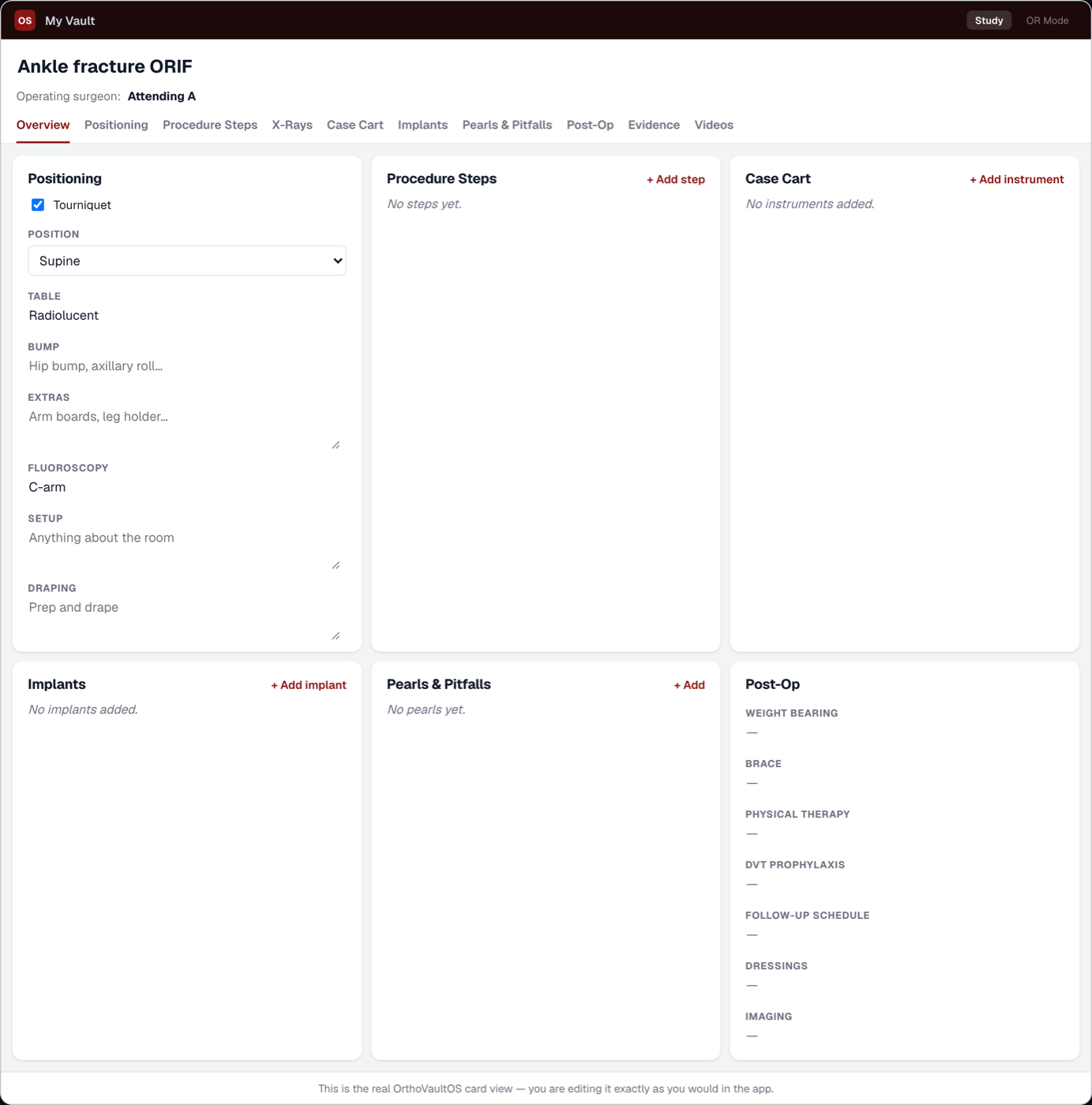
When you work with more than one attending, OrthoVaultOS keeps a card per surgeon for every procedure, so your own notes are always current even when the hospital's card isn't.
Common questions
How often should a surgeon preference card be updated?
At least once a year, and after any change in technique, implants or equipment. In one study, each extra year without an update meant 1.6 more unused items per case.
Who is responsible for updating preference cards?
The surgeon decides what goes on the card. The hospital's perioperative team edits and stores it. Who does the editing varies by hospital, so ask the OR charge nurse who handles cards for your service.
Why are preference cards so often inaccurate?
They are written once and changed only on request. Surgeons in one survey said the main barriers were not knowing the process and the effort it takes. Technique changes over the years, and the card doesn't follow unless someone updates it.
What does it mean to move an item from Open to PRN?
Open means it is opened onto the field at set-up. PRN means it is pulled into the room but stays sealed until someone asks for it. Moving rarely used items to PRN is one of the most common changes in a card review.
Can a resident update an attending's preference card?
A resident can collect the evidence and bring it to the attending. The attending signs off on the changes, and the hospital team makes the edit. Bring the lists, not opinions: what was opened and unused, and what was asked for.
Can I put patient details on my notes for the review?
No. Track items and counts only: what was opened, what was used, what was asked for. No names, record numbers or dates that identify a patient.
References
- Colagiuri P, Pickles K, Hutchins R, Mathieu E. Evaluating the Impact of Surgeon Preference Card Age on Surgical Waste and Costs. Surg Innov. 2026. Link
- Palmisano ZM, Sullivan GA, Petit HJ, et al. Surgeon perspectives on preference cards and environmental stewardship. World J Surg. 2024;48(9):2165-2173. Link
- Harvey LFB, Smith KA, Curlin H. Physician Engagement in Improving Operative Supply Chain Efficiency Through Review of Surgeon Preference Cards. J Minim Invasive Gynecol. 2017;24(7):1116-1120. Link
- Perez S, Mancebo A Jr, Lopez P, et al. Data and the Art of Surgical Preference Card Maintenance. JAMA Surg. 2026;161(1):76-82. Link
- Zygourakis CC, Yoon S, Valencia V, et al. Operating room waste: disposable supply utilization in neurosurgical procedures. J Neurosurg. 2017;126(2):620-625. Link
- Scheinker D, Hollingsworth M, Brody A, et al. The design and evaluation of a novel algorithm for automated preference card optimization. J Am Med Inform Assoc. 2021;28(6):1088-1097. Link
- Bellaire LL, Nichol PF, Noonan K, Shea KG. Using Preference Cards to Support a Thoughtful, Evidence-based Orthopaedic Surgery Practice. J Am Acad Orthop Surg. 2024;32(7):287-295. Link