Training
Handing off a service: pass on what each attending wants
The short version
- A structured handoff program across nine hospitals cut medical errors by 23% and preventable adverse events by 30%.
- In a study of intern sign-outs, the failures came from two things: content left out and a rushed, indirect handoff.
- Hospital preference cards go stale. Nearly half of surgeons in one survey rarely or never update theirs.
It's the last Friday of the rotation. You finally know that one attending wants the leg prepped to the hip, another hates the Bovie on high, and a third will ask for the small fragment set "just in case" every time. On Monday a new resident walks in knowing none of it. By the time they learn it, they'll be rotating out too.
Patient sign-out gets a lot of attention. The service handoff, what each attending wants, usually gets a hallway "they're nice, you'll be fine."
The fast version: one page per attending
Before you leave the service, write one short page for each attending. Keep it to what changes the next resident's first week.
| Section | What to write | Example |
|---|---|---|
| The setup | Position, prep and drape, tourniquet, table. | "Bump under the hip. Prep to the iliac crest." |
| Their kit | Implant system, sizes they reach for, power, sutures. | "Always opens the small frag set. 2-0 then staples." |
| The flow | What you do in their cases, and when they hand over more. | "Lets you close. Exposure after you've shown the steps." |
| The pet peeves | The few things that make them stop the case. | "Wants the C-arm in before the incision." |
| Clinic and rounds | Clinic flow, notes, when to call. | "Text, don't page, unless it's urgent." |
| What's new | Anything they changed this block that the hospital card won't show. | "Switched stem systems in October." |
Keep it to setup, kit and habits. No patient names, record numbers or dates.
Then walk them through it
Paper isn't the handoff. The talk is. Book 20 minutes before your last day, ideally face to face.
- Go attending by attending. Read your page out loud. Let them ask.
- Flag the first week. Which cases are booked, and which attending they'll scrub with first.
- Say what you're unsure of. "I think she changed her closure, ask her." Uncertain is better than wrong.
- Hand over the files. Send the pages, or share the cards, so they have them on Monday.
- Stay reachable. "Text me your first week." Most questions come in the first three days.
Why structure beats a hallway chat
Most of the research on handoffs is about patient sign-out, not attending preferences. But the lesson is the same: what gets passed on depends on how it's passed on.
- A structured handoff cuts errors. In a 2014 study across nine children's hospitals, a resident handoff program (the I-PASS bundle: a mnemonic, training and a written sign-out) went with a 23% drop in medical errors and a 30% drop in preventable adverse events, across 10,740 admissions.
- What fails is predictable. A 2005 study asked interns about sign-outs that went wrong. The failures fell into two groups: content that was left out, and a rushed or indirect handoff. The usual result was uncertainty about what to do next.
A one-page sheet fixes the first problem. A short face-to-face walk-through fixes the second.
Why the hospital card isn't enough
The new resident will have the hospital's preference cards. They help, but they lag behind the surgeon.
- Cards aren't kept up. In a 2024 survey of surgeons, nearly half said they rarely or never update their preference cards.
- Old cards drift. In one hospital study, each extra year of card age went with more unused single-use items per case.
So the card says what was true when someone last edited it. Your page says what this attending did last week. For how to fix the card itself, see how to update a surgeon preference card.
Start the page on day one
The handoff is easy if you've been writing it all along. After each case, add a line to that attending's page: what was new, what they asked for, what you'd tell the next person. That's the habit in what to write down after every case. By the last week, the handoff is already done.
If you want a clean one-page card to hand over, the free preference card builder makes one in your browser, with no account.
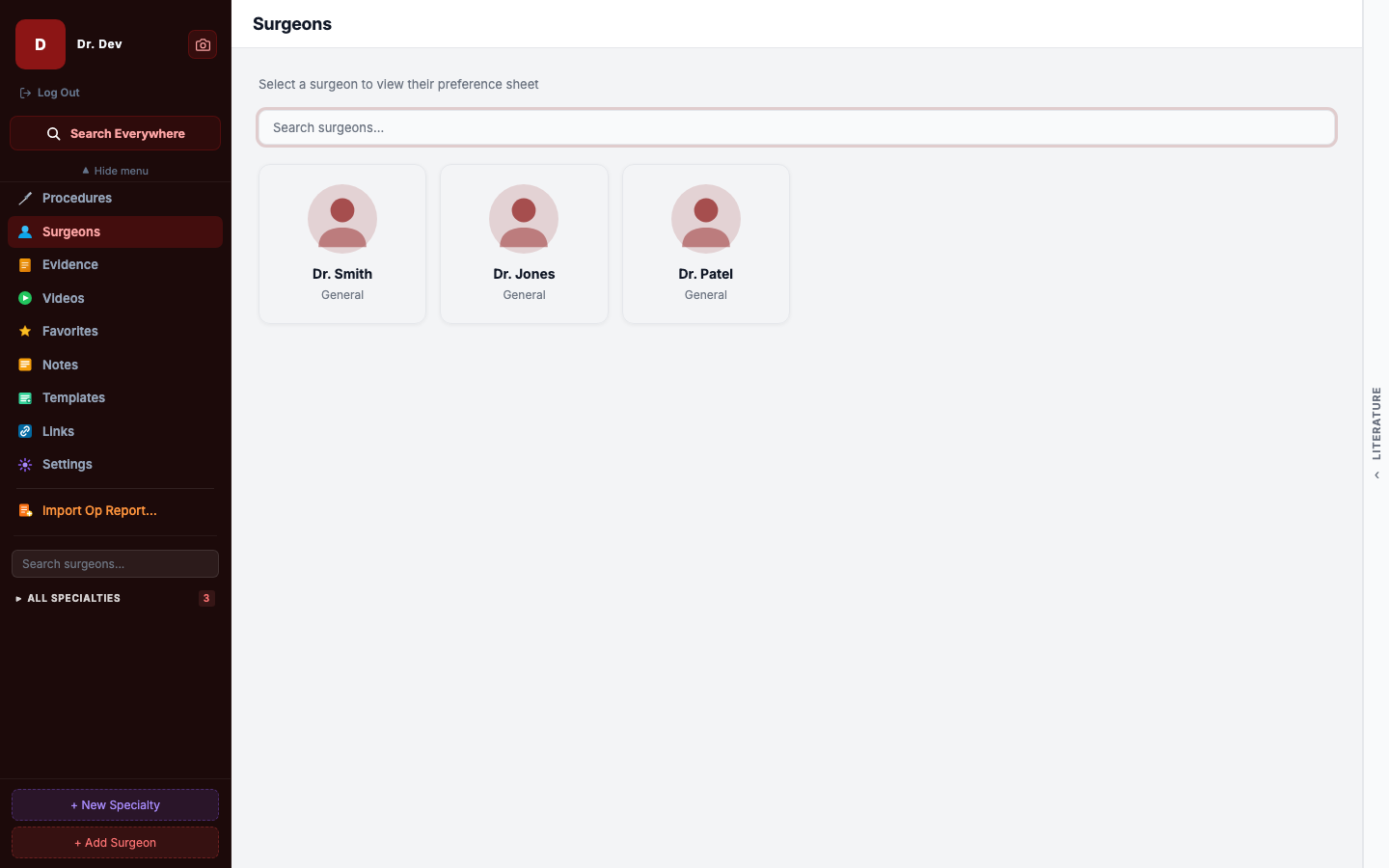
In OrthoVaultOS, every attending gets their own card for each procedure: setup, case cart, implants and pearls. You build it as you go, so on your last Friday you aren't writing from memory. For what goes on a good card, see surgeon preference card examples.
Common questions
What should a resident include in a rotation handoff?
For each attending: their setup, their kit, how they run a case, what they let you do, their pet peeves, and anything they changed recently. Add the first week's booked cases.
How long should a service handoff take?
The page takes a few minutes per attending if you've kept notes. The walk-through takes about 20 minutes. Do it before your last day, not in the parking lot.
Is this the same as patient sign-out?
No. Patient sign-out is about patients on the list. A service handoff is about how the service and each attending work. Both go better with a written list and a face-to-face talk.
Can I just forward the hospital's preference cards?
Send them, but don't stop there. Hospital cards are often out of date, and they don't say how the attending runs the case or what they let a resident do.
Can the handoff page include patient details?
No. Keep it to the surgeon, the procedure and the setup. No patient names, record numbers or dates.
References
- Starmer AJ, Spector ND, Srivastava R, et al. Changes in medical errors after implementation of a handoff program. N Engl J Med. 2014;371(19):1803-1812. PubMed
- Arora V, Johnson J, Lovinger D, Humphrey HJ, Meltzer DO. Communication failures in patient sign-out and suggestions for improvement: a critical incident analysis. Qual Saf Health Care. 2005;14(6):401-407. PubMed
- Palmisano ZM, Sullivan GA, Petit HJ, et al. Surgeon perspectives on preference cards and environmental stewardship. World J Surg. 2024;48(9):2165-2173. PubMed
- Colagiuri P, Pickles K, Hutchins R, Mathieu E. Evaluating the Impact of Surgeon Preference Card Age on Surgical Waste and Costs. Surg Innov. 2026. PubMed
Full procedure cards
Setup, steps, case cart and post-op for one procedure, with references.
- Total Hip Arthroplasty
- Total Knee Arthroplasty
- Lateral Epicondyle Debridement / Repair (Tennis Elbow)
- ACL Reconstruction
- Lateral Ankle Ligament Reconstruction (Broström)
- Distal Radius ORIF (Volar Plate)
- Hemiarthroplasty — Hip Fracture
- Lesser Metatarsal Osteotomy (Weil Osteotomy)
- Carpal Tunnel Release (Open / Endoscopic)
- Scaphoid Fracture ORIF (Headless Compression Screw)
- Congenital Clubfoot — Posteromedial Release
- Scoliosis — Vertebral Body Tethering (VBT)