Technique
What the scrub tech wishes the resident knew before the case
You walk into the room ten minutes before the patient. The scrub tech has three trays open and one question: "Is he using the long stem today, or the standard?" You don't know. You say you'll ask. The attending walks in, and the first thing they ask for isn't on the back table.
The scrub tech isn't asking to test you. They set up the case from the preference card and the trays. Anything the card doesn't say, they have to guess, or wait for someone who knows. Often that someone is you.
The fast version: a two-minute check-in
Find the scrub tech before the patient rolls in. Go through five things.
| Ask or tell | Why it matters to them |
|---|---|
| The plan. Which side, which approach, which implant system and sizes to expect. | They pick which trays to open and which to keep closed. |
| What's new. Anything different from the last time this attending did this case. | The card may be years old. They'll set up the old way unless told. |
| The order. What gets used first, and when the drill, saw or C-arm comes in. | They load the Mayo stand in that order. |
| The "have it ready" items. What this attending asks for that isn't on the card. | Kept close but sealed, so nothing is opened for nothing. |
| The pace. How the attending likes to be handed things, and what makes them stop. | They can hand the next instrument before it's asked for. |
If you don't know an answer, say so now. Asking the attending before scrub is better than finding out at the table.
Why the tray alone doesn't tell them
A tray holds far more than any one case uses. In a 2014 study that watched 49 cases and 237 trays at one academic center, only 13% to 22% of the instruments on a tray were used, depending on the service. Bigger trays had lower use and more instrument errors.
Orthopaedics is no different. One UK orthopaedic department cut its trays for common cases from as many as five per case down to one or two. Staff said the change saved time and was practical.
So the scrub tech is looking at a lot of metal and a card that may be out of date. What they need is the short list: what this attending will actually use today, in what order.
What happens when the team doesn't talk
When something is missing, someone leaves the room to find it. The case pauses. Attention breaks.
- Flow disruptions add up to errors. In a 2007 study of 31 cardiac cases, surgical errors rose as flow disruptions rose. Teamwork and communication failures were the strongest predictor of errors.
- A short briefing helps. In a 2009 pilot, a structured pre-case briefing cut flow disruptions from 5.4 to 2.8 per case. Trips by the circulating nurse out of the room for supplies fell from 10 to 4.7 per case. Time spent out of the room fell from about 400 seconds to about 170.
These were cardiac surgery studies. The lesson travels: say the plan out loud before the case, and fewer things go missing during it.
What the scrub tech knows that you don't
The check-in goes both ways. The scrub tech has often set up for your attending many more times than you have. Ask them:
- "What does Dr. X usually ask for that isn't on the card?"
- "Anything about how they like to be handed instruments?"
- "Anything that went wrong last time?"
Write the answers down after the case, on your own card for that attending and that procedure. This is the same habit as what to write down after every case. Next time, you show up with the answer before they ask.
Keep the answers on one card per attending
Most of what the scrub tech asks lives in your head after one case, and is gone by the next rotation. Keep it on a card for each attending: trays, implant system and sizes, power, and the "have it ready" list. The free preference card builder makes a one-page card in your browser, with no account. If the hospital's own card is stale, see how to update a surgeon preference card.
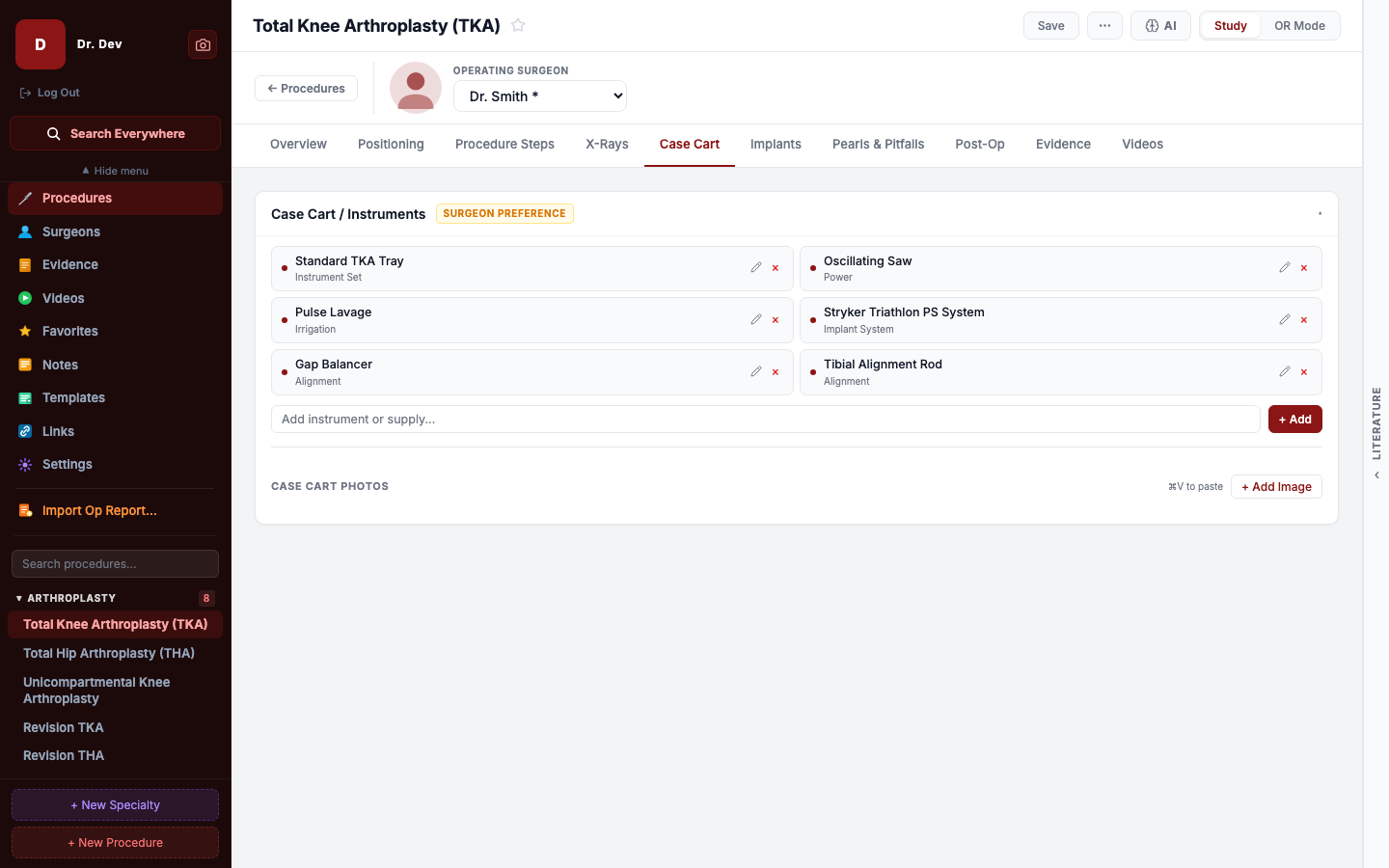
In OrthoVaultOS, each attending gets their own Case Cart and Implants list for every procedure. When the scrub tech asks, you open the card and answer. For what else goes on a card, see surgeon preference card examples.
Common questions
What does a scrub tech do before a case?
They open and check the trays, set up the back table and Mayo stand, and count instruments and sponges with the circulating nurse. They work from the hospital's preference card for that surgeon and procedure.
What should a resident tell the scrub tech before surgery?
The side and approach, the implant system and expected sizes, anything new since last time, the order of the case, and items the attending may ask for that aren't on the card.
Why are so many instruments on a tray unused?
Trays are built to cover many surgeons and many versions of a case. In one study, only 13% to 22% of the instruments on a tray were used in a given case.
Is it okay to ask the scrub tech about the attending's preferences?
Yes. They often know the attending's setup better than a new resident does. Ask before the case, then write it down so you don't have to ask twice.
Can I put patient details on my own preference cards?
No. Keep cards to the surgeon, procedure and setup. No patient names, record numbers or dates.
References
- Stockert EW, Langerman A. Assessing the magnitude and costs of intraoperative inefficiencies attributable to surgical instrument trays. J Am Coll Surg. 2014;219(4):646-655. Link
- Wiegmann DA, ElBardissi AW, Dearani JA, Daly RC, Sundt TM 3rd. Disruptions in surgical flow and their relationship to surgical errors: an exploratory investigation. Surgery. 2007;142(5):658-665. Link
- Henrickson SE, Wadhera RK, Elbardissi AW, Wiegmann DA, Sundt TM 3rd. Development and pilot evaluation of a preoperative briefing protocol for cardiovascular surgery. J Am Coll Surg. 2009;208(6):1115-1123. Link
- Hermena S, Solari F, Whitham R, Hatcher C, Donaldson O. Rationalization of orthopaedic surgical instrument trays: three years' experience of a practical approach to cut down unnecessary costs. Cureus. 2021;13(11):e19866. Link