Technique
Preference card management: who owns the card, and how to keep yours right
The short version
- The surgeon decides what is on the card. Nurses, scrub techs, supply chain and sterile processing keep it running, and an editor, such as a charge nurse or one named person, makes the change.
- Hospitals manage cards with electronic systems, scheduled reviews and national programs such as the ACS Preference Card Optimization Campaign. Cards still drift, partly because 87.6% of surgeons in one survey changed theirs by asking out loud.
- Your own card for each attending holds what the hospital card never will. Update it the same day, and send what you learn to the person who edits the hospital card.
First week on a new service. Your attending asks for a suture that isn't on the field. The circulator says, "That's not on the card." Then everyone looks at you.
You didn't write the card. You don't know who did. But you will be back in that room on Thursday, with the same attending and the same card.
Preference card management sounds like a job for the OR office, and mostly it is. Knowing who owns which part of the card tells you where to send a fix. It also explains why you need a card of your own.
The fast version: who owns what on the card
| Who | What they own | Your move |
|---|---|---|
| The attending | What goes on the card. Every change needs their sign-off. | Bring evidence: what was opened and unused, what was asked for and missing |
| OR nurses and scrub techs | Running the case from the card, and spotting what is wrong with it | Ask what has been off on this attending's card lately |
| The card editor | Making the change in the system. Depending on the hospital, a charge nurse, nurse supervisor, service line lead or one named person in charge of cards | Send the marked-up card once the attending has signed off |
| Supply chain or materials management | Item numbers, stock, and taking obsolete items off | Give exact product names and sizes, not "the usual one" |
| Sterile processing | Keeping the instrument sets matched to the card | Note which trays come back unopened |
| Perioperative and quality leaders | Scheduled reviews and supply-cost projects | Offer to help when your attending's most common case comes up |
| You | Your own card for each attending: how the case actually runs | Update it the same day |
The names change from hospital to hospital. So on day one of a new service, ask the charge nurse one question: who edits the cards for this service?
How hospitals manage preference cards
Most cards live in a system. An article from AORN, the perioperative nurses' association, notes that some cards are built into the electronic record and others are still on paper. Some are tied to the supply and patient charge lists.
Changes go through an editor. AORN articles tell nurses to send corrections to the charge nurse, a supervisor, or whoever is in charge of the cards. In one large health system's 2025 review, surgeons started each update. OR nurses and scrub techs passed the changes to RN service team leads, who confirmed the details and made the edit. Supply chain removed obsolete items, and sterile processing lined up the instrument sets.
Big reviews run on a schedule. That same system set out to review half of its 14,452 active cards in one year. By November 18, it had reviewed 5,591.
National programs push it too. The American College of Surgeons runs a Preference Card Optimization Campaign through its SUSTAIN Collaborative, from August 2026 to August 2027. Each site reviews at least one card, makes at least one improvement, and names a surgeon lead. The ACS guide for the campaign suggests a team of the surgeon lead, an OR nurse, a surgical technologist, a perioperative leader, someone from supply chain or materials management, and a quality improvement representative. Its advice: start with one procedure, and look at the card again after the change to confirm it worked.
Better data helps. In one AORN Journal quality project, an automated inventory system raised preference card accuracy by 7.7% over four months. Average supply cost fell by $86.72 per procedure, and add-on supplies fell by 20%.
Why cards still drift
Even with all that, the card in your room is often behind. The studies point to a few reasons.
- Changes start as a spoken request. In a 2024 survey of 89 surgeons at one academic center, 87.6% made card changes by asking someone out loud. A request made between cases has to survive a hand-off or two before it reaches the editor.
- Few people know the process. In the same survey, 83.7% called the unfamiliar process a barrier. Mid- to late-career surgeons were far less likely to update their cards at least once a year than early-career surgeons (18.9% vs 57.1%).
- Systems can break the link. When a new electronic record arrived in one health system's ORs, it disrupted supply management. A root cause analysis of its orthopaedic cases traced a chief cause to mistimed interface messages, the ones that built the pick lists.
- Cards are rarely reopened. The ACS describes many cards as seldom reviewed once they are made.
None of this is anyone being careless. The hospital card is shared by a lot of people, and shared documents drift.
Your side: a card-management routine of your own
You can't edit the hospital card. You can keep your own, and make it the source of every fix you send.
Where it lives. One place, with one card per attending per procedure. Not a pile of texts, a notes app and the back of a scrub top. Even OR nurses do this: an AORN article notes that some keep personal lists on index cards or in note apps, because a hospital's fixed card format is hard to change.
When you update it.
- Day one on a service. Ask who edits the cards. Pull the hospital card for your attending's two or three most common cases.
- The night before. Read the hospital card and your own. Note where they disagree.
- Same day, after the case. Two lines for the hospital card: what was opened and unused, and what was asked for and missing. Then your own notes for everything else. For what to capture, see what to write down after every case.
- End of the week. Move those notes into the card for that attending. Cross out anything that is no longer true.
- When the attending changes something. A new implant system, approach or set-up. Update your card that day, and ask whether they want the hospital card changed too.
- When the list gets long, or once a year. Run the 15-minute preference card review with your attending, then hand the marked-up card to the editor.
What goes in yours that the hospital card never holds.
- The order of the case, the way this attending runs it
- The hand-off points: what you do, and when they take over
- The two or three things that draw a correction, in their words
- Items they ask for that aren't on the card, so you can ask for them before skin
- Post-op orders the way they write them
Keep patient details out of it. Items, counts and steps only. For a full example laid out section by section, see surgeon preference card examples.
Build your own card, free
The free preference card builder is a card you fill in online, then print or save as a PDF. It covers positioning, steps, case cart, implants and pearls, and needs no sign-up.
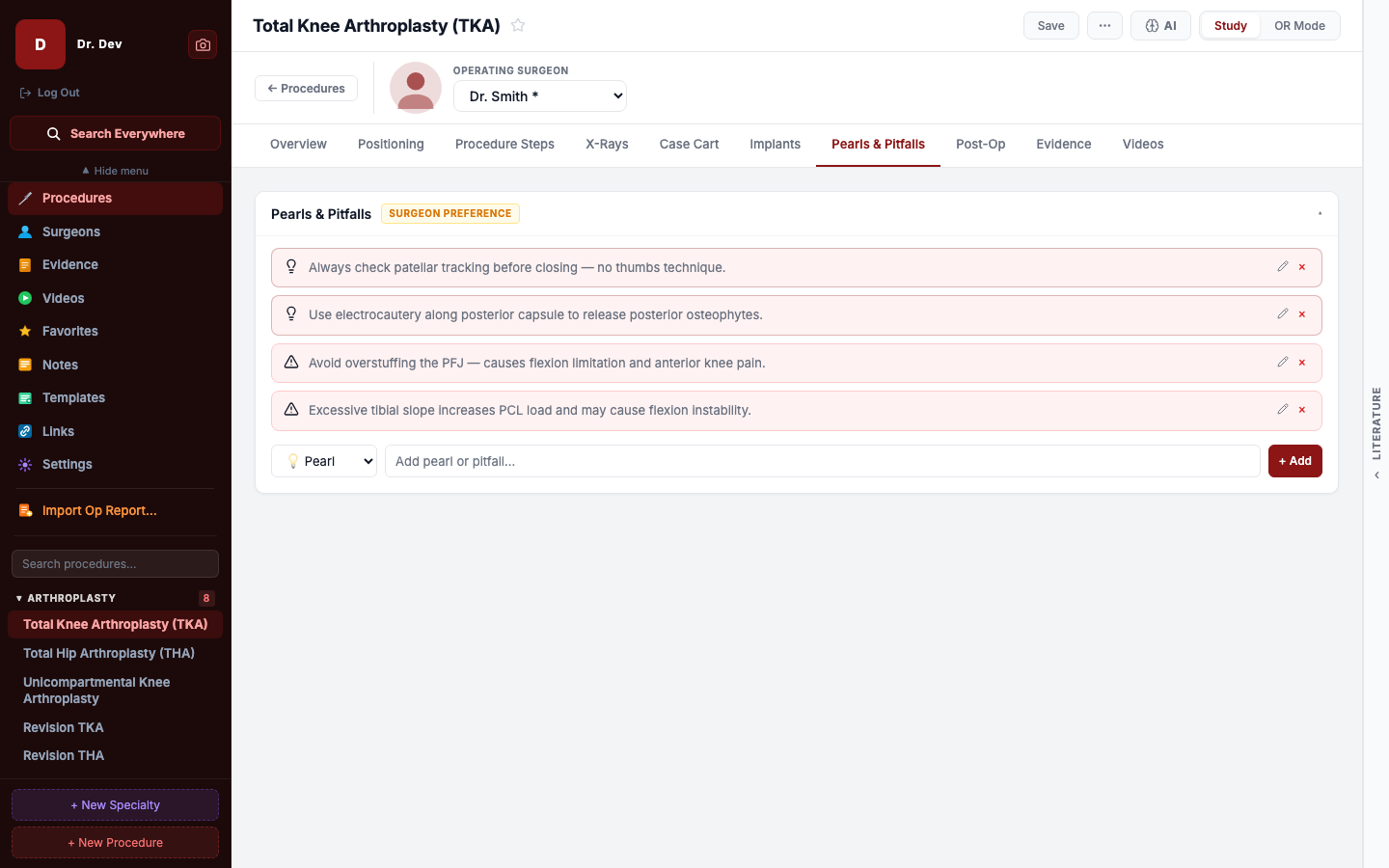
When you work with several attendings, OrthoVaultOS keeps every case the way each attending does it. Pick the operating surgeon and the preference panels switch to theirs: positioning, steps, case cart, implants, pearls and post-op.
Common questions
What is preference card management?
It is how a hospital creates, updates and reviews surgeon preference cards: who asks for a change, who makes the edit, and how often cards are checked. The surgeon approves what goes on the card, and perioperative staff enter the change.
Who is responsible for updating preference cards?
The surgeon decides what is on the card. The edit is made by perioperative staff, such as a charge nurse, nurse supervisor, service line lead or one person in charge of cards, depending on the hospital. Supply chain and sterile processing keep the items and trays matched to it.
How often are preference cards reviewed?
It varies by hospital. Some run large scheduled reviews; one health system aimed to review half of its cards in a single year. The ACS advises looking at a card again after any change to confirm it worked. Your own card should change after every case where something was different.
What is the ACS Preference Card Optimization Campaign?
A national American College of Surgeons program, run through its SUSTAIN Collaborative from August 2026 to August 2027. Participating teams review at least one card, make at least one improvement, and name a surgeon lead.
Why keep my own card if the hospital already has one?
The hospital card says what is in the room. It does not say how your attending runs the case, when you get the drill, or what makes them stop. That part is yours to keep, and it is also where the evidence for a hospital card fix comes from.
References
- American College of Surgeons. How to Optimize a Preference Card in 7 Steps. SUSTAIN Preference Card Optimization Campaign. 2026. facs.org
- American College of Surgeons. SUSTAIN Collaborative: Preference Card Optimization Campaign. 2026. facs.org
- Buria S. Why Do I Need Preference Cards? AORN. 2023. aorn.org
- McKisson E. Never Ask a Surgeon Their Glove Size: The Importance of the Preference Card. AORN. 2025. aorn.org
- Kaiser Permanente Northern California Nursing. Elevating surgical care through collaboration. Annual Report 2025. nursingncal.kaiserpermanente.org
- Palmisano ZM, Sullivan GA, Petit HJ, et al. Surgeon perspectives on preference cards and environmental stewardship. World J Surg. 2024;48(9):2165-2173. PubMed
- Dizon JM, Richesson RL, Lytle KS, Hawks SJ. Factors Disrupting the Preference Card Management Process: A Root Cause Analysis. AORN J. 2016;103(1):105.e1-12. PubMed
- Rocchio BJ, Chipps E, Gorsuch P, Wills CE. Automating Perioperative Inventory Management: A Quality Improvement Project. AORN J. 2023;117(3):177-186. PubMed
Full procedure cards
Setup, steps, case cart and post-op for one procedure, with references.
- Total Hip Arthroplasty
- Total Knee Arthroplasty
- Lateral Epicondyle Debridement / Repair (Tennis Elbow)
- ACL Reconstruction
- Lateral Ankle Ligament Reconstruction (Broström)
- Distal Radius ORIF (Volar Plate)
- Hemiarthroplasty — Hip Fracture
- Lesser Metatarsal Osteotomy (Weil Osteotomy)
- Carpal Tunnel Release (Open / Endoscopic)
- Scaphoid Fracture ORIF (Headless Compression Screw)
- Congenital Clubfoot — Posteromedial Release
- Scoliosis — Vertebral Body Tethering (VBT)