Technique
Preference card vs pick list vs case cart: what each one is
The short version
- The preference card is the surgeon's standing list. The pick list is printed from it for one booked case. The case cart is what sterile processing actually loads from that pick list.
- Most misses happen at a hand-off: a case booked under the wrong procedure, a card change the list never saw, a missing tray, a vendor set that came in late.
- None of the three holds how your attending does the case: the order, the hand-offs, the things that make them stop. That part you keep yourself.
It is 6:45 in the morning. The case cart is parked outside your room with a printout in a bin on the side. An hour in, your attending asks for a retractor. The circulator checks the printout: never pulled. The scrub tech says it's on the card.
They can both be right. The card, the printout and the cart are three different things, made by different people at different times. Knowing which is which tells you where to look when something is missing.
The fast version
| Document | Who writes it | Who uses it | What it holds | What it never holds |
|---|---|---|---|---|
| Preference card | The OR team, from what the surgeon asks for. The surgeon owns the content | Everyone who prepares the case | The standing list for one surgeon and one procedure: trays, supplies, equipment, drugs, positioning, each marked Open or PRN | Anything about today: the side, the sizes, what changed last month |
| Pick list (pick ticket) | Nobody by hand. It prints from the card for one booked case | Sterile processing or materials staff, to pull the items | One case: room, time, each item and how many, then marks for anything short | A card change made after it printed |
| Case cart | Sterile processing staff, from the pick list | The circulator and scrub tech, to set up the room | What was actually pulled, plus the marked-up pick list | Anything not on the pick list, or not found |
| Your own card | You | You, before you scrub | How this attending does this case: setup, order, hand-offs, what makes them stop | Patient details |
The names are not fixed. The American College of Surgeons terminology guide lists procedure cards and case setup cards as other names for preference cards, and notes some hospitals call the card itself a pick list. A 2018 surgical editorial adds "fad list." If your OR uses the words differently, go by theirs.
The other words you'll hear
- Open and PRN (or hold). Open items are opened onto the field during setup. PRN items come into the room but stay sealed until someone asks.
- Trays and sets. Named groups of reusable instruments. The card lists the tray, not every instrument inside it.
- Peel packs and backup trays. A single instrument wrapped on its own, or a spare tray. The ACS guide names these as where rarely used instruments go when trays get trimmed.
- Packs and kits. Bundles of single-use items such as back table drapes, basins, gowns and suction tubing, usually prepared by supply chain vendors.
- Loaner sets. Instruments the hospital borrows from a vendor for a case, sometimes with the implants in the same set.
One case, from card to room
How one elective case moves, and where each step breaks. Details vary by hospital.
1. The case is booked, and that picks the card
A 2007 OR Manager article by one health system's OR leaders put it plainly: the preference list is chosen when the case is scheduled. Each booking uses a set procedure name, and that name is tied to a card. If the booking doesn't match what the surgeon means to do, the scheduler guesses, and a wrong guess prints the wrong list.
That hospital gave the people booking cases each surgeon's procedure list, and cleaned up its cards. Turnover fell by more than 8 minutes per case, and returns from the room fell by at least one item per case.
Vendor sets get requested here too. In one academic center's loaner policy, the surgeon's office calls the vendor at booking, and loaner sets are due 48 hours before the day of surgery so there is time to process them.
What breaks: a primary booked when the plan is a revision. A vendor nobody called.
2. The pick list prints
The pick list is the card turned into one job. At the hospital in the OR Manager article, the pick ticket printed 72 hours before the case, and the case was picked the day before.
What breaks: a stale card makes a stale list, and a change requested after the list printed may not reach this case. If your attending changed something this week, assume the list doesn't know yet. For why cards drift and how to fix one, see how to update a surgeon preference card.
3. Sterile processing builds the cart
One academic center's written procedure shows the job. Staff pull cases in order of location and start time, and build carts for scheduled cases the day before. They write the quantity next to each item as they pull it, circle anything missing on the pick ticket, and leave the ticket with the cart. Missing items also go on a sheet for restocking.
Loaner sets go through the same department. The loaner policy above has every loaner set cleaned and sterilized on site before each case, even one that arrives sterile from an outside facility. Sets with implants are held until the biological indicator, a spore test of the sterilizer load, comes back negative.
What breaks: an item out of stock, a tray still in processing, an instrument missing from inside a set. In one study, trained observers watched seven pediatric ORs over a summer and logged 236 instrument errors across 147 cases. Missing items were the most common, at 160. Delays averaged about 10 minutes per case.
4. The cart reaches the room
The circulator and scrub tech set up from the cart: Open items onto the field, PRN items close and sealed. The marked-up pick list shows what's short, if someone reads it.
What breaks: the cart can match the card exactly and still be wrong for today. The card doesn't know the side, the sizes, or that your attending switched systems in the spring. A study that mapped instrument delivery at two hospitals found 172 and 158 possible failure points, and no single system that showed all the relevant information.
What to check before the case
The night before:
- The booking. Does the scheduled procedure match the plan? If not, the card and the list are wrong too. Tell the circulator or charge nurse early.
- Vendor sets. If the case needs a vendor's instruments or implants, ask whether the set has arrived and been processed, and whether the rep is coming.
- The cart. Ask whether anything is marked short on the pick list.
- What's not on the card. If the attending will want something that isn't listed, ask for it as PRN: in the room, but sealed.
- What changed. If the attending does something differently now, say so before setup, not at the table. What the scrub tech wishes you knew has a two-minute check-in for this.
The part none of these hold
Every document above answers one question: what should be in the room. None says what your attending does first, where you stand, when they hand you the drill, or what makes them take the case back.
That part is in your head after one case and gone by the next rotation, unless you write it down. Keep one card per attending and procedure: setup, order of steps, implants and sizes, the "have it ready" items, and the two or three things that drew a correction. For what that looks like, see surgeon preference card examples.
The free preference card builder makes a one-page card in your browser, with positioning, steps, case cart, implants and pearls. No sign-up, and nothing is uploaded.
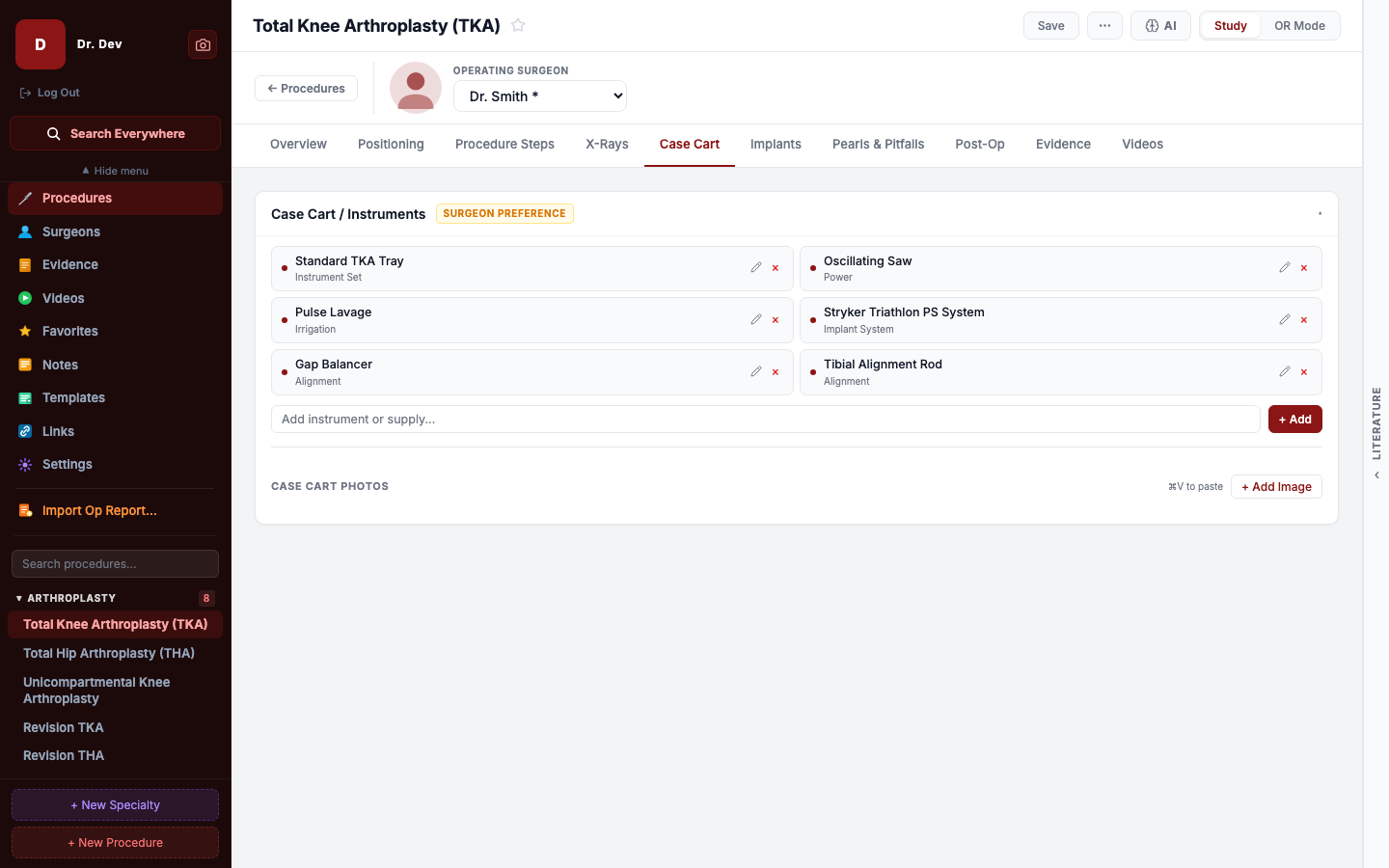
In OrthoVaultOS, every procedure has a Case Cart and an Implants tab for each surgeon, alongside positioning, steps, pearls and post-op. Pick the operating surgeon and the lists change with them. It is your record, not a replacement for the hospital's card.
Common questions
What is the difference between a preference card and a pick list?
The preference card is the standing list for one surgeon and one procedure. A pick list is printed from that card for one booked case, and sterile processing or materials staff use it to pull the items. Some hospitals use both names for the same document.
What is a case cart in the OR?
A cart loaded with the trays, packs and supplies for one case. Sterile processing builds it from the pick list, and it goes to the room before the case. At one academic center, carts for scheduled cases are built the day before.
What is a loaner tray?
A set of instruments, sometimes with implants, that a vendor lends the hospital for a case. At one academic center, every loaner set is cleaned and sterilized on site before use, and sets are due 48 hours before the day of surgery.
Can I put patient details on my own card?
No. Keep it to the surgeon, the procedure and the setup. No names, record numbers or dates that identify a patient.
References
- American College of Surgeons. Preference Card Optimization Campaign: Terminology Guide. 2026. facs.org
- Dempsey C, Larson K, Shockley T. Winning the battle for accurate, updated surgeon preference lists. OR Manager. 2007;23(11). periopleader.com
- Huntley JS, Howard JJ, Simpson J, Sigalet DL. Updating the surgical preference list. Cureus. 2018;10(7):e2997. DOI
- University of Toledo Medical Center, Sterile Processing. Procedure SP1-5: Case cart set-up. Revised December 2025. utoledo.edu
- University of Toledo Medical Center, Sterile Processing. Procedure SP1-8: Case cart missing items list. Revised December 2025. utoledo.edu
- The Ohio State University Wexner Medical Center, Department of Perioperative Services. Policy: Loaner Instrument Trays. wexnermedical.osu.edu
- Nichol PF, Saari MJ, Navas N, et al. Observed rates of surgical instrument errors point to visualization tasks as being a critically vulnerable point in sterile processing and a significant cause of lost chargeable OR minutes. BMC Surg. 2024;24:110. PubMed
- Guédon AC, Wauben LS, van der Eijk AC, et al. Where are my instruments? Hazards in delivery of surgical instruments. Surg Endosc. 2016;30(7):2728-2735. PubMed
Full procedure cards
Setup, steps, case cart and post-op for one procedure, with references.
- Total Hip Arthroplasty
- Total Knee Arthroplasty
- Lateral Epicondyle Debridement / Repair (Tennis Elbow)
- ACL Reconstruction
- Lateral Ankle Ligament Reconstruction (Broström)
- Distal Radius ORIF (Volar Plate)
- Hemiarthroplasty — Hip Fracture
- Lesser Metatarsal Osteotomy (Weil Osteotomy)
- Carpal Tunnel Release (Open / Endoscopic)
- Scaphoid Fracture ORIF (Headless Compression Screw)
- Congenital Clubfoot — Posteromedial Release
- Scoliosis — Vertebral Body Tethering (VBT)