Technique
Surgeon preference card template: one attending, one case
The short version
- Copy the blank card below. Part 1 is what the hospital card holds: positioning, prep and drapes, gloves, trays, implants, sutures, dressings, and what is opened versus held PRN.
- Part 2 is yours: the steps in this attending's order, where you take over, what they stop the case over, and how they write the post-op orders.
- The night before, spend 10 minutes filling what you can find and circle the rest. The circled lines are your questions for the morning.
It is 9 pm. Tomorrow's list has a distal radius with an attending you have never scrubbed with. The hospital's preference card, if you can find it, says which trays get pulled. It does not say which screws they put in first, when you get the drill, or what makes them take it back.
So here is a card you can fill in: one attending, one procedure, two halves. Copy it into your notes app, print it, or build the same card in the free builder at the end.
The blank template
SURGEON PREFERENCE CARD
Procedure: ____________________________
Attending: ____________________________
Last updated: ________

PART 1. WHAT THE ROOM NEEDS (the hospital card's half)
Position: ______________  Table: ______________
Bumps and positioners: ______________________
Arm board, leg holder, extras: ______________
Fluoroscopy: ______________  Comes in from: ______
Tourniquet: yes / no   Where: ________   Inflated: ______
Prep: ______________  Drapes: ______________
Gloves (attending): ______   Gown: ______
Trays and sets: ____________________________
Instruments they ask for by name: ____________
Implant system: ______________  Rep needed: yes / no
Sizes usually opened: ______________________
Sutures, by layer: _________________________
Dressing / splint: _________________________
Open at set-up: ____________________________
PRN (in the room, left sealed): ______________

PART 2. HOW THIS ATTENDING RUNS IT (yours)
Steps, in their order:
  1. ____________________________
  2. ____________________________
  3. ____________________________
  4. ____________________________
  5. ____________________________
  6. ____________________________
Where I take over: _________________________
Where they take it back: ____________________
What they stop the case over: _______________
Lines they repeat every time: _______________
Post-op orders:
  Weight bearing: ________  Brace / splint: ________
  Therapy: ________  DVT prophylaxis: ________
  Follow-up: ________  Imaging: ________
  Dressing change: ________
Read before the case: _______________________
One card is one attending and one procedure. If two attendings do the same case differently, that is two cards.
No patient details anywhere on it: no names, record numbers or dates that identify anyone. The card is about technique and preference, and it needs nothing else.
Why it has two halves
Part 1 is what a hospital card already holds. The American College of Surgeons describes preference cards as surgeon- or procedure-specific lists of "the supplies, instruments, equipment, medications, positioning needs" a case requires. That includes items pulled into the room but left sealed unless someone needs them. That is your PRN line.
In orthopaedics, a 2024 review in the Journal of the AAOS notes that these cards are usually built when a surgeon is hired, and that few health systems have a way to support keeping them optimized. So copy Part 1 from the real card when you can, and expect a line or two to be out of date.
Part 2 is the half no hospital card holds, because it is not about the room. It is the order this attending works in, where you get to operate, and what makes them stop. That is the part you are judged on. For a real hospital card read line by line, see surgeon preference card examples.
A filled example: distal radius ORIF with a volar plate
This is an illustrative card for a common case, not a recommendation. The standard details come from the AO Surgery Reference. Everything that changes from attending to attending is left blank on purpose, because that is exactly what you have to find out.
| Line | Example entry |
|---|---|
| Position | Supine, forearm on a hand table, shoulder abducted so surgeon and assistant can sit on either side |
| Fluoroscopy | The arm has to sit so you get full AP and lateral images of the distal radius. Which unit, and from which side: ____ |
| Tourniquet | Non-sterile pneumatic. Inflated, and when: ____ |
| Prep, drapes, gloves, trays | ____ (copy from the hospital card, or ask the scrub tech) |
| Implants | Volar locking plate, system: ____. K-wires for provisional fixation, size: ____ |
| Sutures, dressing | ____ by layer. Splint or soft dressing: ____ |
| Step 1 | Palmar approach. Modified Henry, or the more ulnar approach that also exposes the median nerve: ____ |
| Step 2 | Reduce and hold with K-wires |
| Step 3 | Plate on, just proximal to the watershed line, not past it. Position checked on fluoro |
| Step 4 | Screws: distal locking screws first, or a shaft screw through the oblong hole first: ____ |
| Step 5 | Final images, including a lateral angled about 20 degrees to see the joint surface |
| Hand-offs | Who opens, who places the K-wires, who drills: ____ |
| Stop-the-case | ____. One standard pitfall worth knowing: a screw beside Lister's tubercle can look fine on the lateral and still be long, which puts the extensor tendons at risk |
| Post-op | Elevation and finger, elbow and shoulder motion from the start. Wrist splint, and for how long: ____. First visit for wound and sutures: ____ |
Look at how many blanks are left. The AO reference itself notes that some surgeons immobilize the wrist for 7 to 10 days before wrist motion and some do not, and that some avoid reducing with the plate in osteoporotic bone because they worry the screws will loosen. Those differences are the whole reason Part 2 exists.
Fill it in 10 minutes the night before
- Minutes 0 to 2: Part 1. If you can see the hospital's card, copy the positioning, implants and Open and PRN lines across. If you can't, leave them for a two-minute check-in with the scrub tech in the morning. What the scrub tech wishes you knew covers what to ask.
- Minutes 2 to 5: the steps. Write the standard steps from your usual technique reference, one line each. Then mark every step where surgeons choose: the approach, the reduction, which screws go first. Each mark becomes a blank for this attending.
- Minutes 5 to 7: ask someone who has scrubbed with them. One text to a co-resident or the chief: what do they do first, what do they let you do, what do they stop the case over? Write the answers in their words, not yours.
- Minutes 7 to 9: post-op. Weight bearing, splint or brace, therapy, DVT prophylaxis, follow-up, imaging. If you don't know how this attending writes them, leave the line blank. A guess on a card gets trusted later.
- Minutes 9 to 10: circle what is still blank. Those are your questions. Ask one or two before the case starts, not all of them.
Then turn the circled lines into a short list you read before you scrub. See how to build your own pre-case checklist.
After the case, the same day: fill in the circles, cross out anything that was wrong, and change the "Last updated" date. A card you fill in once and never touch goes stale the same way the hospital's does.
Make the same card in the free builder
The free preference card builder makes this card with the same blocks: positioning and draping, procedure steps, case cart, implants with sizes, pearls and pitfalls, and post-op. The post-op block has the same seven lines as the template. A few lines go in a slightly different place:
- Prep, drapes and gloves: the Draping and Setup boxes.
- Sutures, dressings, Open and PRN items: the Case Cart, one line each.
- Hand-off points: write them into the step where they happen, for example "Distal screws (I drill)".
- What they stop the case over: Pearls & Pitfalls, marked as a pitfall.
It runs in your browser, needs no account, prints a one-page card or copies it as plain text, and nothing you type is uploaded while you fill it in. There is also a blank PDF on the same page if you'd rather print a stack and write by hand.
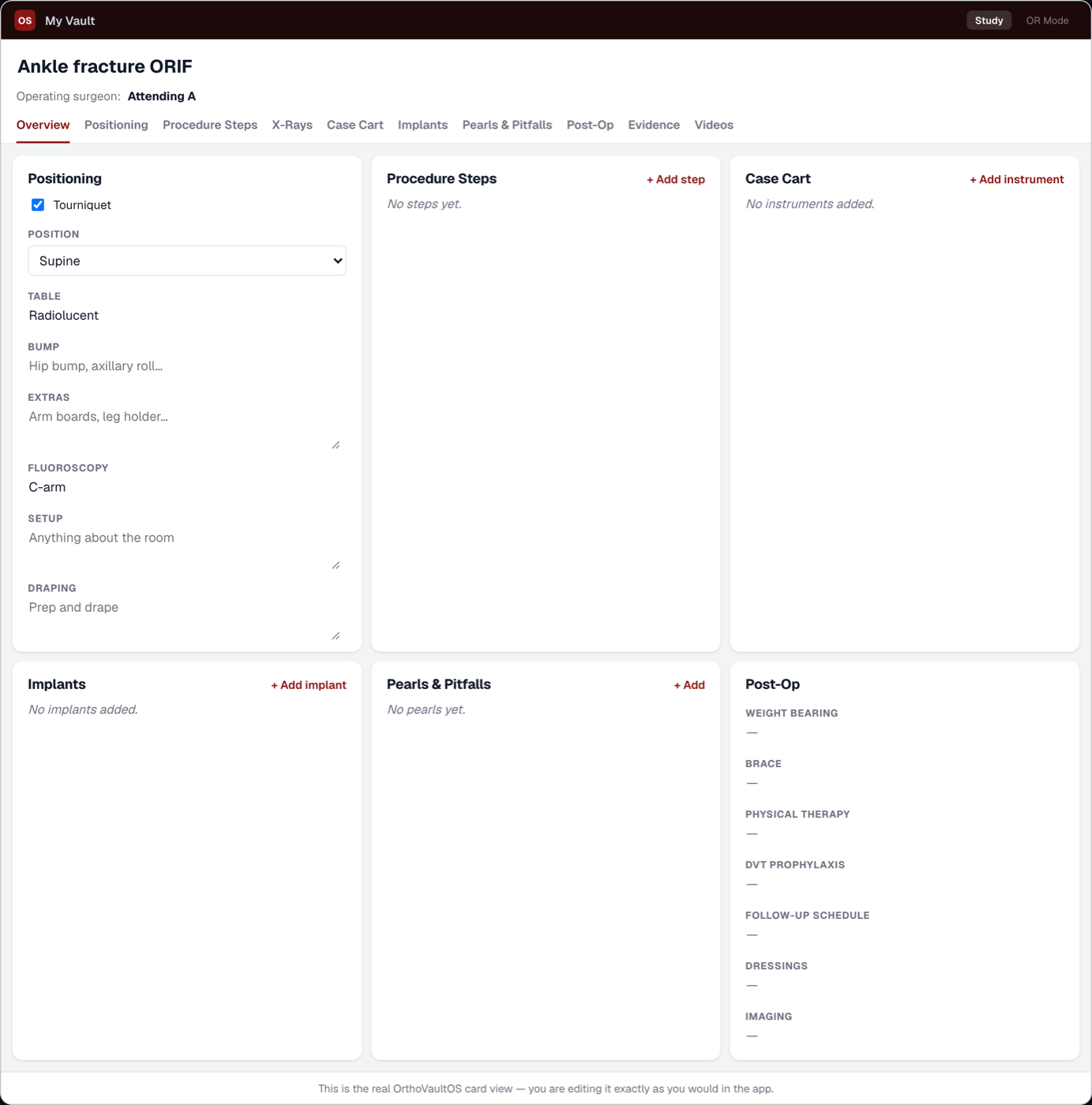
Once you have cards for more than one attending, OrthoVaultOS keeps every attending case the way that attending does it: positioning, steps, case cart, implants, pearls and post-op. You pick the operating surgeon, and the preference panels switch to theirs.
Common questions
Is there a free surgeon preference card template?
Yes. Copy the blank one above, use the free builder, or print the blank PDF from the builder page. None of them needs an account.
What should a surgeon preference card include?
For the room: positioning, prep and drapes, gloves, trays, implants and sizes, sutures, dressings, and what is opened versus held PRN. For you: the steps in this attending's order, the hand-off points, what they stop the case over, and their post-op orders.
Should I just copy the hospital's card?
Copy it into Part 1 as a starting point, then check it against what was actually opened. In orthopaedics, cards are usually built when the surgeon is hired, and few hospitals have a routine for keeping them current.
Can I put patient details on my card?
No. Keep technique and preference only: no names, record numbers or dates that identify a person.
References
- American College of Surgeons. Preference Card Optimization Campaign: Terminology Guide. 2026. facs.org
- Bellaire LL, Nichol PF, Noonan K, Shea KG. Using Preference Cards to Support a Thoughtful, Evidence-based Orthopaedic Surgery Practice. J Am Acad Orthop Surg. 2024;32(7):287-295. PubMed
- Fricker R, Jupiter J, Kastelec M. Supine (palmar approaches). AO Surgery Reference, adult trauma, distal forearm. surgeryreference.aofoundation.org
- Fricker R, Jupiter J, Kastelec M. ORIF, palmar plate: extraarticular fracture of the radius with dorsal displacement or tilt. AO Surgery Reference. surgeryreference.aofoundation.org
Full procedure cards
Setup, steps, case cart and post-op for one procedure, with references.
- Total Hip Arthroplasty
- Total Knee Arthroplasty
- Lateral Epicondyle Debridement / Repair (Tennis Elbow)
- ACL Reconstruction
- Lateral Ankle Ligament Reconstruction (Broström)
- Distal Radius ORIF (Volar Plate)
- Hemiarthroplasty — Hip Fracture
- Lesser Metatarsal Osteotomy (Weil Osteotomy)
- Carpal Tunnel Release (Open / Endoscopic)
- Scaphoid Fracture ORIF (Headless Compression Screw)
- Congenital Clubfoot — Posteromedial Release
- Scoliosis — Vertebral Body Tethering (VBT)